Harpsichord players create contrast through timing,
articulation, texture, and ornament rather than force
(Pilkington, 1935). This means the instrument does not
simply lack expression, but it organizes it differently
instead, favoring precision and clarity over continuous
dynamic shaping.
The instrument's limits also shift attention toward small differences in rhythm and articulation. These micro-variations can become more musically significant than dynamic force because expression comes from how a gesture is shaped rather than how loudly a note is played (Pilkington, 1935).
Case Study
Domenico Scarlatti · Sonata in C Major, K. 159
Because the harpsichord cannot create gradual dynamic changes through touch, Scarlatti's sonata depends on quick articulation, rhythmic energy, repeated notes, and sharp contrasts between registers. This piece feels bright and animated not because the performer can shape each note with volume, but because the mechanism encourages clarity, precision, and gesture. So, in this example, expression comes from how notes are placed and articulated, rather than how they swell or fade.
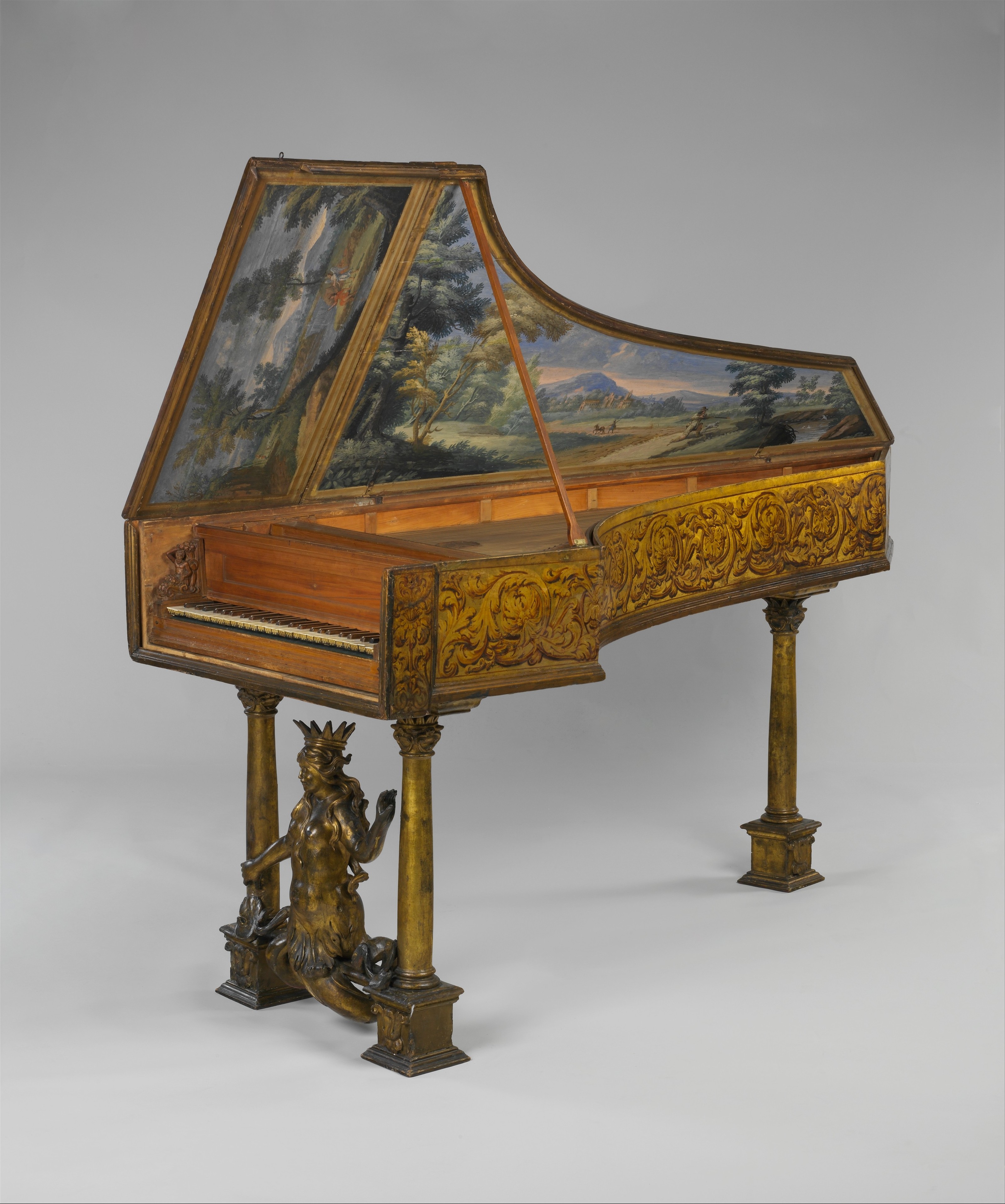
The Metropolitan Museum of Art. (n.d.). Harpsichord (Object No. 45.41a-c) [Musical instrument]. https://www.metmuseum.org/art/collection/search/503625
What Changes
- Performers shape expression through timing, articulation, and phrasing.
- Listeners attend to rhythmic vitality and textural clarity.
- Instrumental constraint actively structures style.
Bartolomeo Cristofori's early piano design introduced a
hammer mechanism in which the force applied to a key
shapes how strongly the hammer strikes the string. As a
result, loudness becomes responsive to touch in a way
that was unavailable on the harpsichord (Giordano,
2016).
This innovation was not simply mechanical, but expressive since the piano made it possible to shape musical lines through continuous variation in intensity, altering how phrases could be written, performed, and heard. By contrast, the harpsichord's plucking mechanism produces a more fixed volume, so expressive contrast depends more on articulation and texture than dynamic gradation.
Case Study
W. A. Mozart · Piano Sonata in C Major, K. 545
The opening theme is simple and balanced, but its character depends on touch, phrasing, and small dynamic changes. We can see that unlike the harpsichord, the fortepiano allows the performer to shape volume directly through the keys, so musical expression becomes more connected to the physical pressure of the hand. The piece shows how dynamics begin to function not just as decoration, but as part of the structure and personality of the phrase.
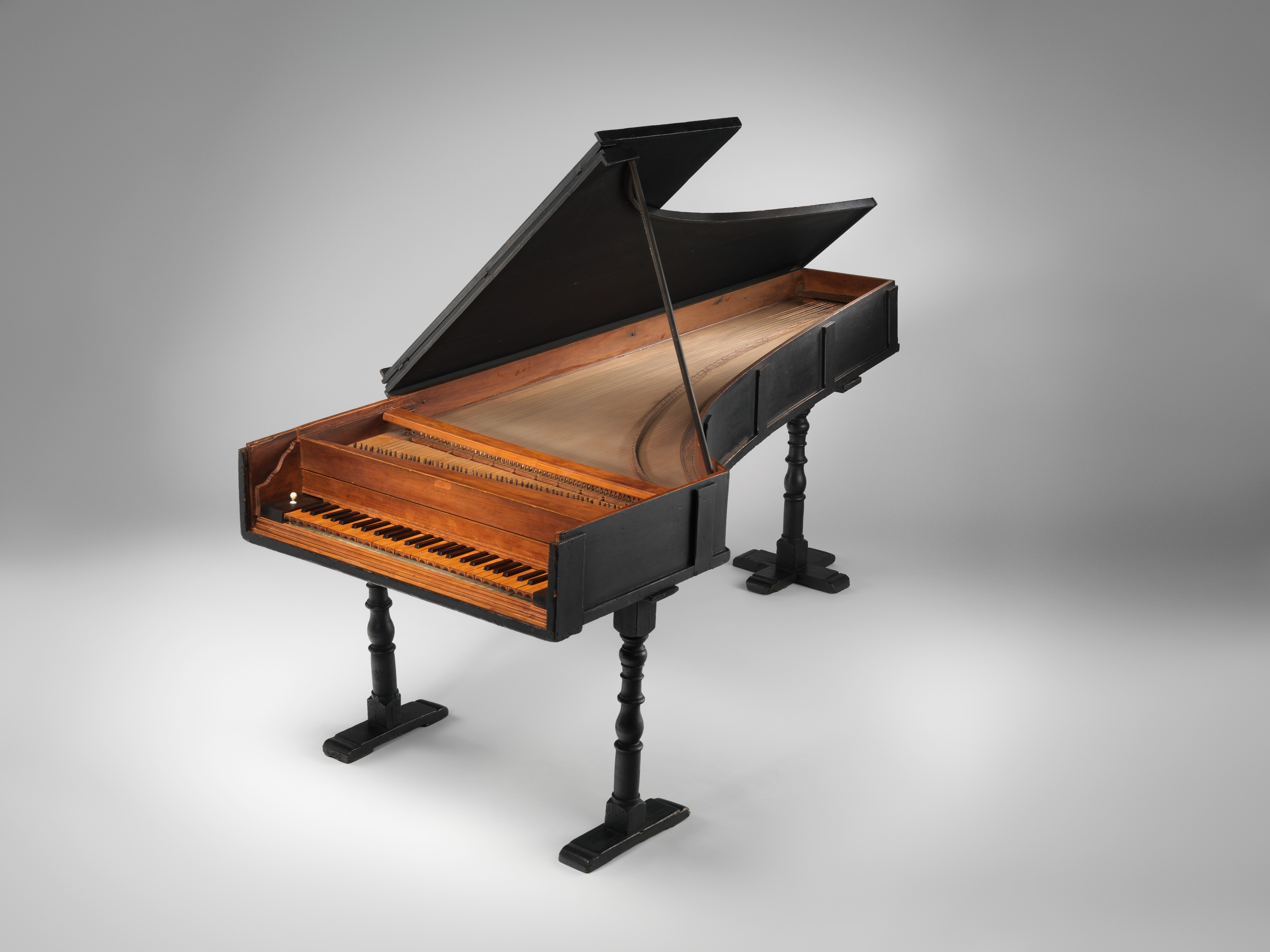
The Metropolitan Museum of Art. (1720). Piano (Object No. 89.4.1219) [Musical instrument by Bartolomeo Cristofori].
What Changes
- Touch becomes central to musical meaning.
- Composers write for dynamic contour and phrase shaping.
- Listeners begin hearing nuance as structure.
Between roughly 1750 and 1850, the piano underwent major
structural transformations in its strings, materials,
case, and overall construction. Stronger materials,
including iron and eventually steel wire, allowed
strings to withstand greater tension, which contributed
to a more powerful and sustained sound (Giordano, 2016).
These changes made it possible for tones to project more
fully and resonate longer, expanding the instrument
beyond the more immediate decay of earlier keyboards.
At the same time, the range of the piano expanded significantly, giving composers a broader sonic space to work within (Giordano, 2016).
Case Study
L. van Beethoven · Piano Sonata Op. 27 No. 2
Especially during the first movement of this sonata we can listen how expression depends more on resonance and continuity. For example, the repeated triplet pattern creates a sustained atmosphere, while the melody seems to float above the texture rather than stand apart from it. This kind of writing depends on a piano capable of supporting longer sounds and more connected harmonic space. We can hear how the instrument makes it possible for expression to emerge through mood, suspension, and gradual unfolding, rather than through direct contrast alone.
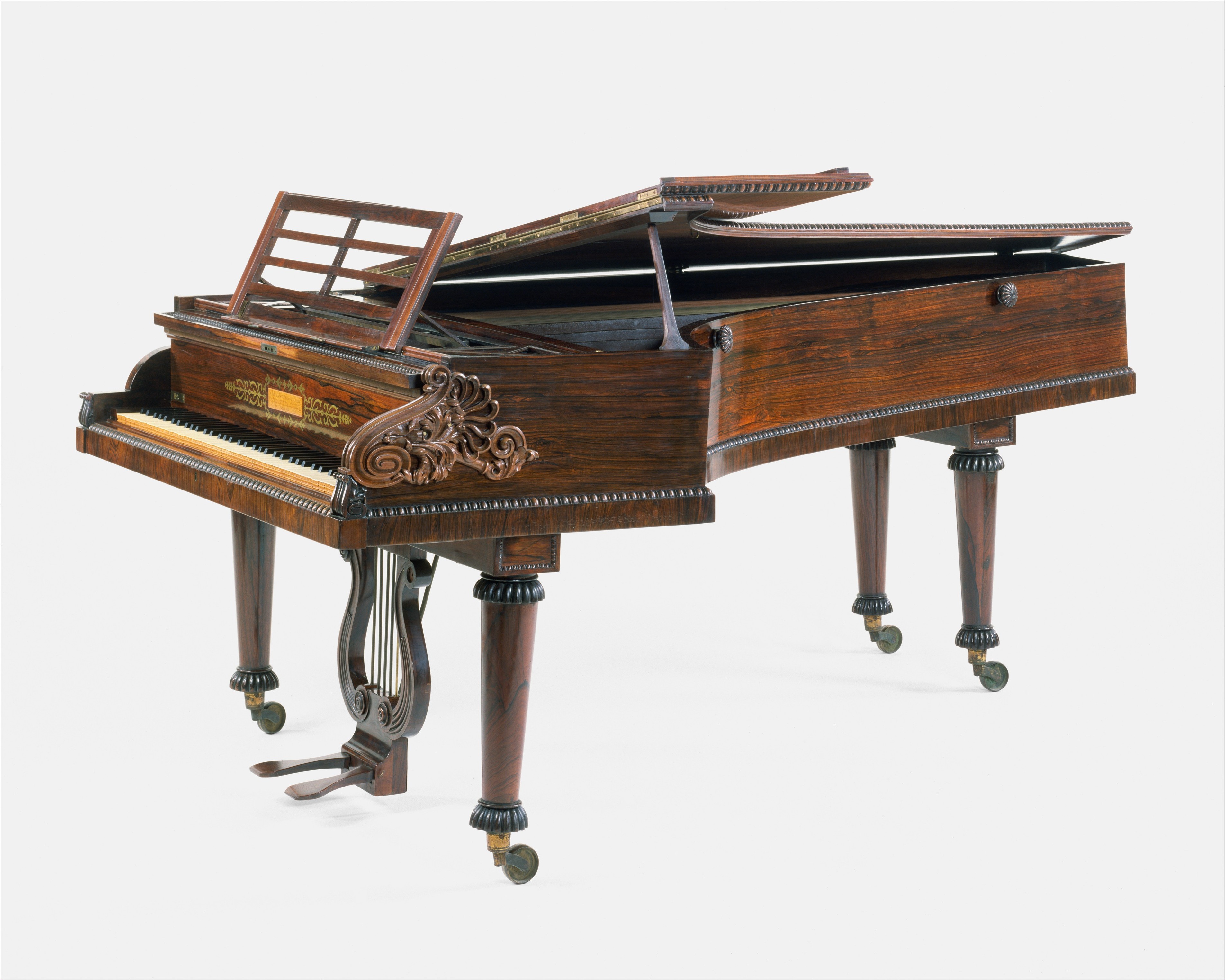
The Metropolitan Museum of Art. (1827). Grand piano (Object No. 1972.109) [Musical instrument by John Broadwood & Sons].
What Changes
- Composers think more in terms of register, pedal, and sonic environment.
- Performers shape continuity across longer spans.
- Listeners hear a more continuous expressive field.
One of the most important nineteenth-century innovations
was the cast-iron frame, which allowed the piano to
withstand much higher string tension without structural
failure. This made it possible to increase both volume
and sustain, expanding the expressive capabilities of
the instrument (Tomes, 2021).
These structural changes are directly tied to musical practice, for example, with increased sustain and power composers could write music that relies on broader dynamic contrasts, denser textures, and more dramatic gestures. The piano is no longer limited to clarity and nuance, but becomes capable of orchestral effects and large-scale sonic projection.
Case Study
Franz Liszt · Hungarian Rhapsody No. 2
We can hear throughout this piece dramatic contrasts, dense textures, rapid passages that rely on the piano's ability to project, and moments of sustained resonance. More than playing notes accurately, the piece asks the performer to turn physical force, speed, and spectacle into part of the musical experience. In this example, the piano becomes almost orchestral, capable of filling a concert space and making virtuosity itself a central expressive feature.
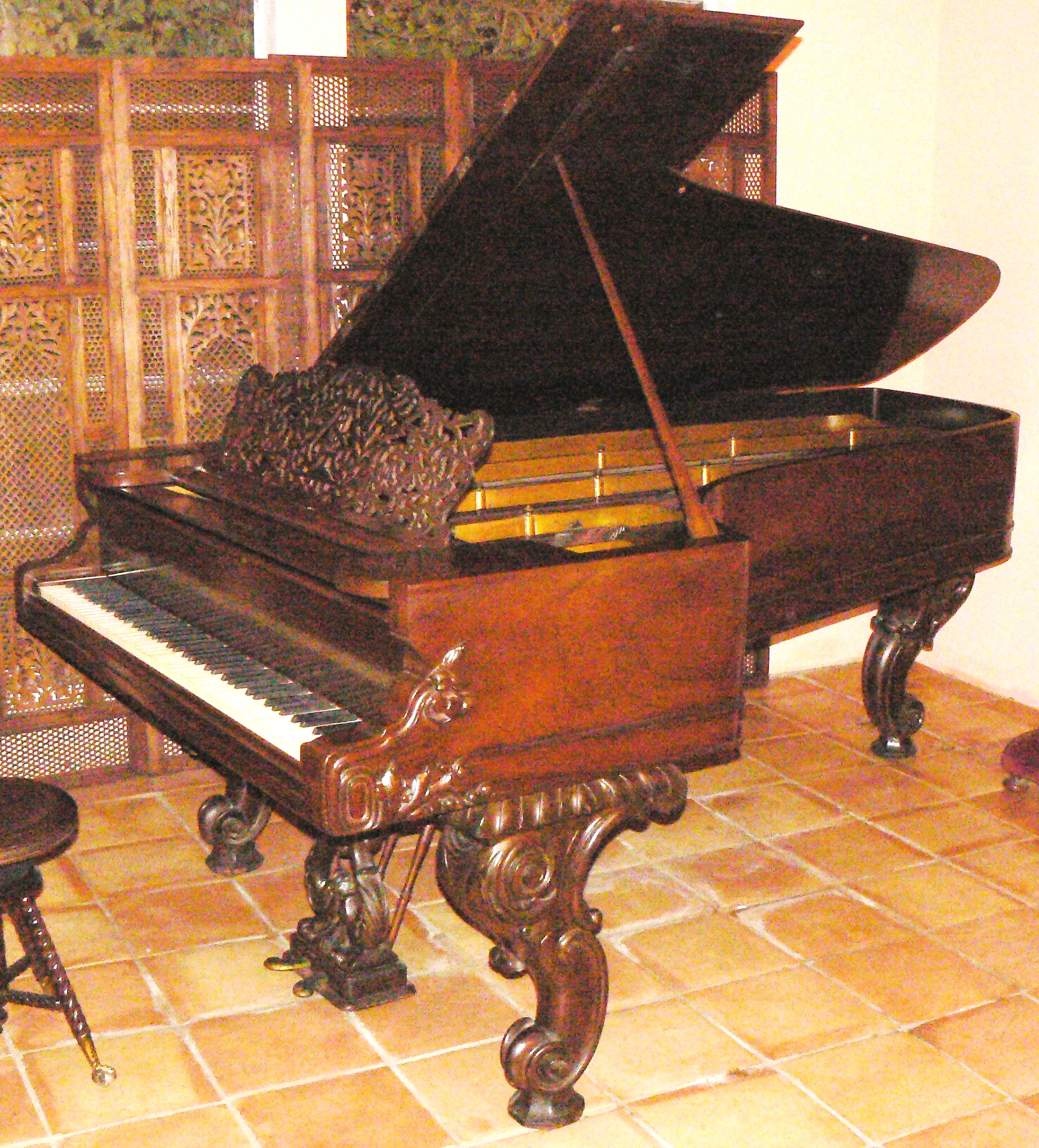
Sigal Music Museum. (n.d.). Oldest original Steinway piano, patented 1858. https://sigalmusicmuseum.org
What Changes
- Performers need more force, endurance, and control.
- The piano becomes suitable for large public spaces.
- Virtuosity becomes part of the instrument's identity.
This shift reflects a broader reorientation in twentieth-century musical thinking, where modern musical practices increasingly treat sound itself as material. So, we start seeing a shift from traditional notions of the instrument as a stable source of specific pitches and timbres, toward a more fluid conception in which the instrument can be modified to produce a wider range of sounds (Katz, 2004). In this context, the prepared piano more than having a new sound, redefines the possibilities of what the piano can be.
Case Study
John Cage · Sonatas and Interludes
Cage's Sonatas and Interludes starts with playful sounds produced by the dynamic between what the string of certain keys are touching. The keyboard sound remains familiar, but the sounds it produces become metallic, percussive, muted, making the listening experience unpredictable.
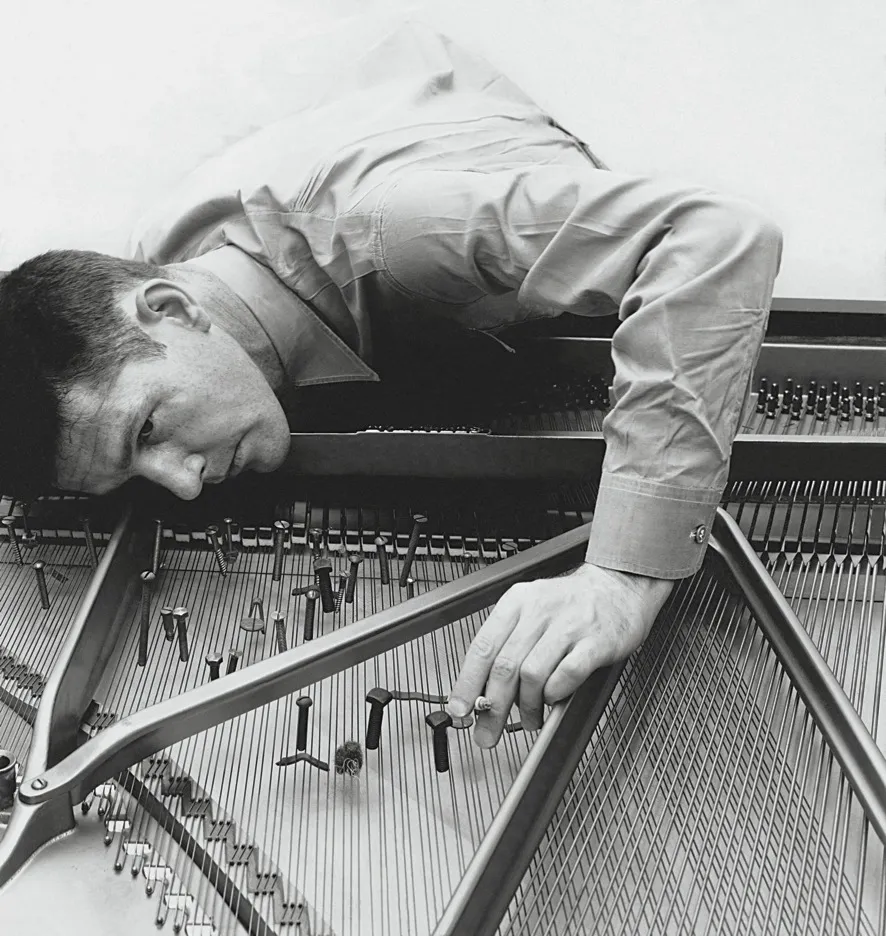
Cage preparing a piano, in 1947. Photograph by Irving Penn / © 1947 (Renewed 1975) Condé Nast Publications Inc.
What Changes
- Composition becomes the design of sonic conditions, not only pitches.
- Performers engage with the instrument's internal setup.
- Listeners hear the piano as fluid rather than stable.
MIDI, or Musical Instrument Digital Interface, changes
the relationship between performance and sound by
creating a shared language for musical devices. Rather
than transmitting audio itself, MIDI sends information
about musical action, including note values, note-on and
note-off messages, velocity, and other control data.
This means that a gesture made on one controller can
trigger, shape, or manipulate sound somewhere else
(Romo, 2018).
This standard emerged from a practical problem in the early 1980s: synthesizers and electronic instruments from different manufacturers could not easily communicate with each other. By establishing a common protocol, MIDI made it possible for keyboards, synthesizers, computers, and later digital audio workstations to interact within one musical system. In this context, expression depends not only on what sound is produced, but on how gesture is mapped, stored, edited, and transformed across devices (Romo, 2018).
Case Study
André Mehmari · Prophet 5 Improvisation
Mehmari's improvisation shows how electronic instruments change the expressive role of the keyboard. Unlike an acoustic piano, the Prophet 5 does not depend on strings, hammers, or resonance inside a wooden body. Its sound is shaped through electronic parameters such as timbre, envelope, filtering, and modulation. In this example, expression comes not only from which notes are played, but from how the sound itself is designed and transformed. This connects to MIDI's larger importance because both electronic synthesis and MIDI systems separate the keyboard gesture from one fixed acoustic sound source.
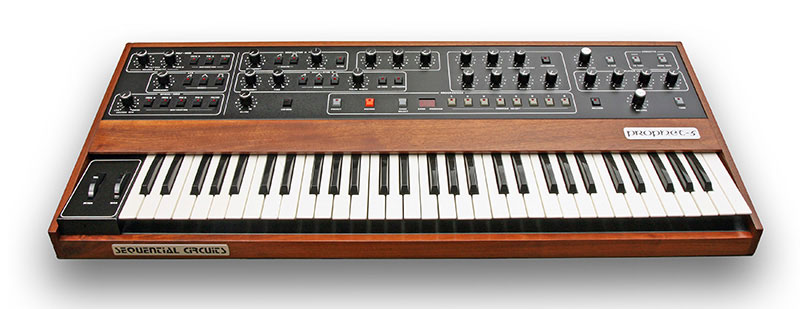
Sequential. (2018, August 31). Prophet-5 40th anniversary. Sequential.
What Changes
- Musical gesture becomes data that can be transmitted, stored, edited, and reassigned.
- Performers work through interfaces that mediate the relationship between action and sound.
- Composers and producers can design systems of control, not only individual sonic outcomes.
Tod Machover's hyperinstrument project began from the
desire to connect musical intelligence, human
performance, and computer systems more closely. The goal
was not simply to make electronic instruments louder or
more complex, but to create systems that could collect
performance data, interpret it, and produce a musical
response in real time (Machover, 1992).
In this model, the instrument is no longer only the physical object being played, it includes the performer, the traditional instrument, the sensors or controllers, and the computer system that processes the performance. Machover describes this as a way to bring the performer and computer closer together, so that gesture, sound, structure, and response can be connected within one continuous musical process (Machover, 1992).
Case Study
Simon Kaplan · Triptych for Hyperpiano
In the broader context of hyperinstrument thinking, Triptych for Hyperpiano shows how the piano can become part of a responsive performance system. This piece sounds to me like a mix between Cage's Sonatas and Interludes and Mehmari's Prophet 5 improvisation, with a blend of acoustic resonance and electronic transformation. The piano is still present as a physical instrument, but its sound is shaped in real time by the performer's gestures and the computer's responses.
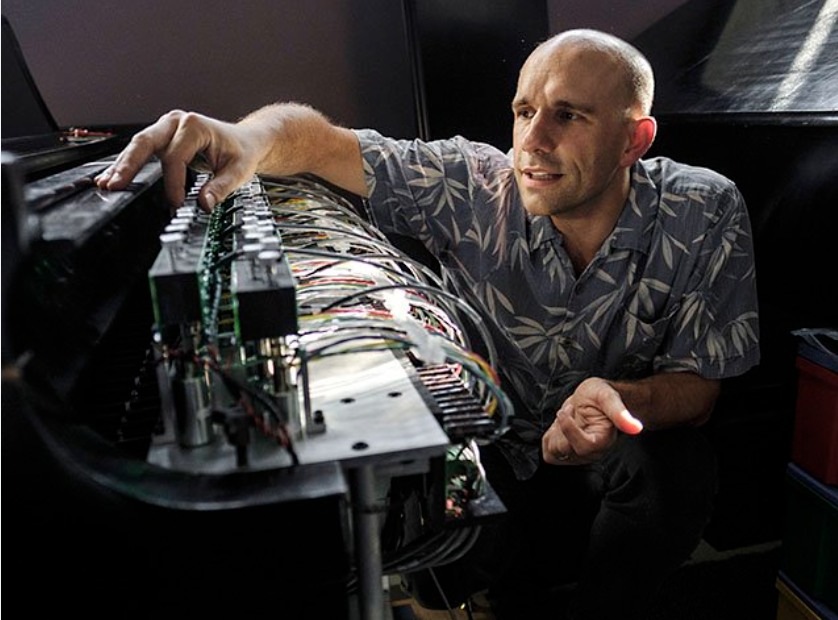
Musteikis, P. (2016, September 22). [Photograph]. In C. Capellaro, The grand design. Isthmus.
What Changes
- The instrument becomes a system that includes performer, gesture, sensors, software, and sound.
- Composers design relationships and responses rather than fixed sequences alone.
- Listeners hear both human intention and computational behavior unfolding together.
Throughline
- 1 Mechanism shapes gesture.
- 2 Gesture shapes sound.
- 3 Sound shapes style.
- 4 New interfaces reshape listening itself.
This chart gathers the exhibit's main throughline into one view. Each instrument changes the balance between mechanism, gesture, sound, and listening, but the same expressive questions keep returning in new forms: What can the performer control? What does the instrument resist? What kinds of musical style does the technology make possible?
| Instrument | Main Mechanism | Expressive Strength | Main Limitation | Style Encouraged | Connection to Later Instruments |
|---|---|---|---|---|---|
| Harpsichord | Plucked strings | Clarity, articulation, rhythmic precision | Limited touch-based dynamics | Ornament, gesture, texture, and contrast through timing | Shows how constraint can organize expression |
| Fortepiano | Hammer action controlled by touch | Dynamic nuance and phrase shaping | Less power and sustain than later pianos | Expressive melody, contrast, and structural dynamics | Introduces touch as a central musical technology |
| Romantic Piano | Expanded range, stronger strings, longer resonance | Sustain, atmosphere, continuity, and harmonic color | Still tied to acoustic decay and physical resonance | Longer phrases, pedal effects, and emotional intensity | Expands the piano from note-making into sound-space |
| Industrial Piano | Cast-iron frame and higher string tension | Projection, volume, density, and virtuosity | Can privilege power and spectacle over intimacy | Concert virtuosity, dramatic contrast, and orchestral textures | Turns the piano into a public, large-scale instrument |
| Prepared Piano | Objects placed inside the piano | Timbre, percussion, surprise, and sonic transformation | Preparation fixes or limits certain sounds in advance | Experimental texture, altered resonance, and sound as material | Reimagines the instrument from within instead of replacing it |
| Digital / MIDI | Gesture encoded as data | Editability, programmability, and timbral flexibility | Gesture and sound can feel separated or less physically direct | Sequencing, sound design, remixing, and post-production control | Separates musical action from one fixed sound source |
| Hyper-Instruments | Sensors and responsive systems | Real-time interaction between performer, gesture, and system | Depends on designed mappings that may be complex or unstable | Interactive performance, expanded gesture, and human-machine co-agency | Extends keyboard history toward responsive musical systems |
Synthesis: From Mechanism to Interaction
This exhibit begins with an idea that musical style is not
shaped only by composers, performers, or historical aspects,
but also by instruments themselves. Across the history of
keyboard instruments, each technological shift creates new
expressive possibilities changing what musicians can imagine
and what listeners are trained to hear through the way an
instrument produces sound, responds to touch, sustains
resonance, projects volume, or translates gesture into data.
Rather than a story of progress, where each instrument becomes
“better” than the last, we see an ongoing change in
relationships between mechanism, body, sound, and musical
meaning.
The harpsichord makes this clear because its limits are also
the foundation of its style since the instrument plucks
strings rather than striking them with touch-sensitive
hammers, performers cannot shape volume in the same gradual
way they can on the piano. However, this does not make the
harpsichord expressionless, instead expression moves into
articulation, timing, ornament, texture, and rhythmic clarity.
For example, in Scarlatti's music, the instrument's attack and
quick decay encourage brilliance, precision, and gesture.
Then, the fortepiano changes this relationship by making touch
central with the hammer mechanism where the performer's
physical pressure can shape dynamics directly, which allows
phrasing, contrast, and musical structure to depend more
strongly on degrees of loudness and softness.
As the piano develops through the nineteenth century,
expression expands again with stronger strings, larger ranges,
improved construction, and eventually the cast-iron frame
allow the piano to become more resonant, powerful, and public.
For instance, Beethoven's “Moonlight” Sonata depends on
resonance and continuity, while Liszt's virtuoso writing
depends on projection, density, and physical force. So, these
instruments do not only support new styles, but they encourage
composers to think differently about musical space, drama, and
the performer's body. At that point in time, the piano becomes
capable of intimacy, atmosphere, and spectacle.
I believe the prepared piano interrupts this narrative of
expansion with John Cage, they do not make the piano louder or
more technically refined, but transforms it from within by
placing objects between the strings they turn the piano into
an instrument where timbre, percussion, and unpredictability
become central. So, this shows to us that technological change
in music is not always about improvement, but sometimes about
disruption, defamiliarization, and hearing an old instrument
as if it were new.
Next, the digital and MIDI instruments shift the question
again since sound no longer has to come directly from the
physical mechanism being played, wee see gesture becoming data
that can be edited, reassigned, copied, or transformed.
Hyper-instruments extend this even further by making the
system responsive in real time with the performer no longer
only controlling an instrument, but interacting with a
technological environment that interprets them.
For me, the website format helped make this argument more concrete because the project moves between text, images, and audio, asking the viewer not just to read about these changes, but to notice them as sonic and material differences. By the end, keyboard history appears less like a timeline of objects and more like a continuous redefinition of what musical expression can be.
References
Scholarly and Historical Sources
- Cole, Michael. Transition from Harpsichord to Pianoforte - the important rôle of women . 2002.
- Giordano, Nicholas. The Invention and Evolution of the Piano. 2016.
- Hess, Albert G. The Transition from Harpsichord to Piano. 1953.
- Katz, Mark. Capturing Sound: How Technology Has Changed Music. University of California Press, 2004.
- Machover, Tod. Hyperinstruments: A Progress Report 1987-1991. MIT Media Laboratory, Massachusetts Institute of Technology, 1992.
- Pilkington, C. Vere. The Harpsichord: Its Present and Future. 1935.
- Romo, Taylor. MIDI: A Standard for Music in the Ever Changing Digital Age. California State University, Monterey Bay, 2018.
- Tomes, Susan. The Piano: A History in 100 Pieces. Yale University Press, 2021.
Musical Works and Listening Examples
- Beethoven, Ludwig van. Piano Sonata No. 14 in C-sharp minor, Op. 27 No. 2 (“Moonlight”) . 1801.
- Cage, John. Sonatas and Interludes. 1946-1948.
- Kaplan, Simon. Triptych for Hyperpiano. YouTube video. https://www.youtube.com/watch?v=MXwsWBq9LQQ
- Liszt, Franz. Hungarian Rhapsody No. 2. 1847.
- Mehmari, André. PROPHET 5 Improvisation by André Mehmari (No Talking, Only Music) . YouTube video. https://www.youtube.com/watch?v=916eWS-gguQ
- Mozart, Wolfgang Amadeus. Piano Sonata in C Major, K. 545. 1788.
- Scarlatti, Domenico. Sonata in C Major, K. 159. c. 1730s.